
Hot Rolled vs Cold Rolled Steel: Which One Should You Buy?

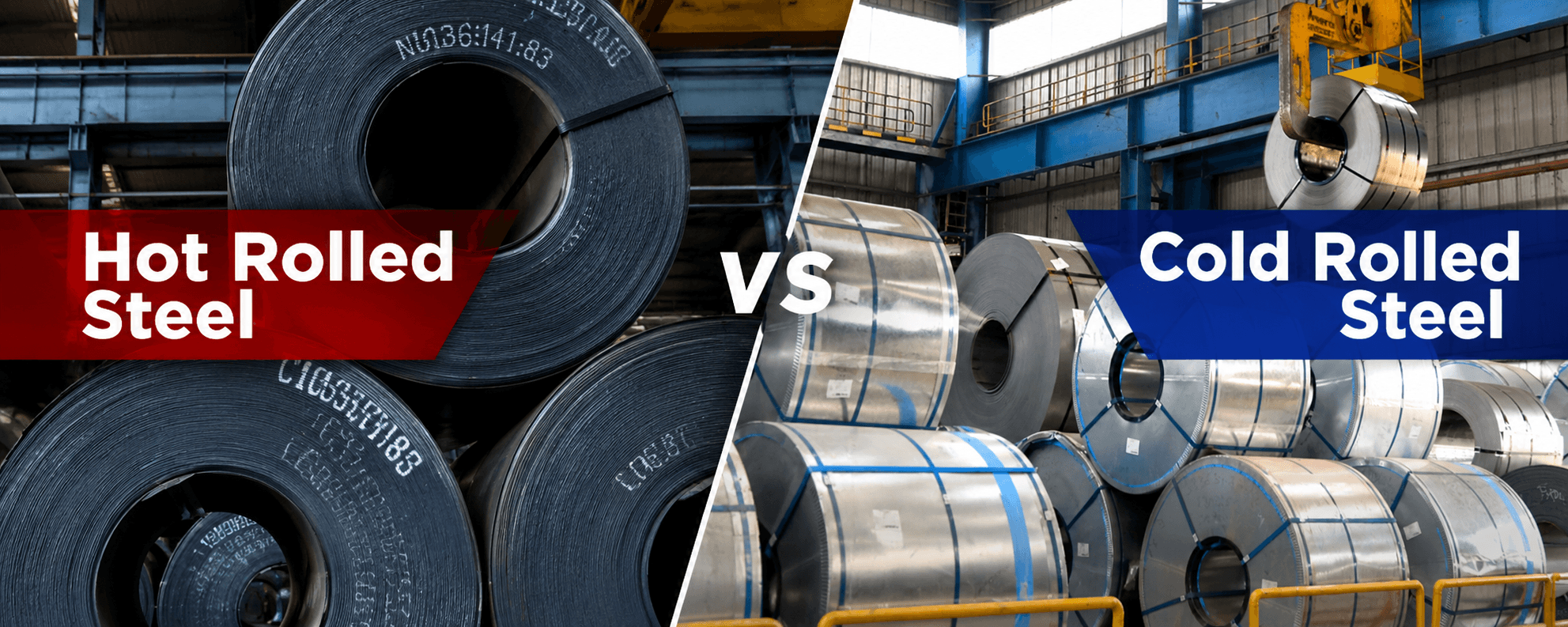
Choosing the right steel is not simply about selecting a grade or thickness. The rolling method also affects the material’s cost, surface finish, dimensional accuracy and suitability for the final application. Understanding hot rolled vs cold rolled steel can therefore help procurement teams avoid paying for unnecessary processing—or choosing a product that cannot meet the required tolerances.
The main difference between hot and cold rolling is the temperature at which the steel is processed. That difference influences the material’s appearance, dimensions and mechanical properties. For most buyers, the decision comes down to four questions: What is the application? How precise must the dimensions be? Is surface finish important? What is the available budget?
What Is Hot Rolled and Cold Rolled Steel?
Hot rolled steel is steel that is rolled at a temperature above its recrystallisation temperature. At this high temperature, the material is easier to shape and can be produced efficiently in large sections, plates, sheets and coils. As the steel cools, slight dimensional changes and a scaled surface may develop.
Cold-rolled steel usually begins as hot-rolled steel and undergoes further processing at or near room temperature. It is passed through rollers to achieve more accurate dimensions, a smoother surface and, depending on the product and processing route, improved strength and hardness.
In simple procurement terms, the cold and hot rolling process serves different priorities. Hot rolling is generally preferred when cost, availability and structural performance are important. Cold rolling is often selected when appearance, precision and tight dimensional tolerances matter more.
Difference Between Hot Rolled vs Cold Rolled Steel
The following table explains the key difference between hot rolled and cold rolled steel from a buyer’s perspective:
| Factor | Hot Rolled Steel | Cold Rolled Steel |
| Processing temperature | Rolled above the steel’s recrystallisation temperature (typically over 900°C) | Hot rolled steel that is further processed at or near room temperature, usually after pickling |
| Surface finish | Typically rougher, with mill scale | Smoother, cleaner and more uniform |
| Dimensional accuracy | Wider tolerances due to uneven cooling and shrinkage | Tighter tolerances and greater dimensional consistency |
| Edge and shape | Edges may be slightly rounded; minor distortion or warping can occur | Sharper, more defined edges and more consistent shape |
| Mechanical properties | Generally more ductile and easier to form, with lower strength and hardness | Higher strength and hardness due to work hardening, with reduced ductility unless annealed |
| Internal stress | Usually lower residual stress, as the steel is not work hardened | Cold working can introduce residual stress unless the steel is annealed afterwards |
| Cost | Generally more economical | Usually more expensive because of the additional processing |
| Typical products | Coils, plates, beams and structural sections | Sheets, coils, strips, precision components and finished panels |
| Common applications | Construction, infrastructure, fabrication and heavy engineering | Automotive components, appliances, furniture and precision products |
This difference between hot and cold rolling does not make one option universally better. The correct choice depends on the drawing, specification, forming requirements, surface expectations and total project cost.
Hot Rolled Steel: Properties, Benefits & Applications
Hot rolled steel is used all over the place in construction, infrastructure and general engineering as it’s got good practical performance and is very cost-effective.
Key properties and benefits include
- Good ductility and formability
- Suitable for welding and fabrication, subject to the selected grade and procedure
- Economical for high-volume and large-section requirements
- Available in a broad range of thicknesses, widths and forms
- Well suited to applications where extremely tight tolerances are not essential
Common hot rolled steel applications include structural frames, bridges, industrial sheds, machinery, railway-related fabrication, storage tanks and general engineering components. Typical products include structural steel, beams, plates and HR coils.
Buyers looking for a reliable hot rolled steel supplier should consider the required grade, thickness, dimensions, and standards before placing an order. Hot rolled steel is a practical choice when the material will be used in a load-bearing structure, fabricated into a large component or covered by further processing such as blasting, machining, painting or coating.
However, the correct grade, thickness, testing requirement and applicable standard must always be confirmed before purchase. “Hot rolled” describes the processing route; it does not by itself confirm that a product meets a specific structural or engineering requirement.
Cold Rolled Steel: Properties, Benefits & Applications
Cold rolled steel is the choice when the purchaser needs greater dimensional control and a smoother, more consistent finish. The extra processing leads to a better surface finish and enables the manufacturer/fabricator to work to tighter tolerances.
Key properties and benefits include
- Smooth and uniform surface finish
- Better dimensional accuracy
- More consistent thickness and shape
- Sharper, cleaner edges in suitable product forms
- Potentially higher strength and hardness due to cold working
- Suitable for visible parts and precision fabrication
Cold rolled steel is commonly used in automotive parts, home appliances, electrical panels, office furniture, cabinets, shelving and precision components. It is often the better option when the steel surface will remain visible or when accurate bending, stamping and assembly are required.
For applications where surface finish and dimensional accuracy are critical, working with a reputable cold rolled steel supplier will help the buyer to identify the right product to meet their technical and fabrication requirements.
Procurement teams should select cold rolled steel where drawings call for close tolerances, good surface finish or where the part is required to fit precisely with other components. They should also confirm the temper, formability, surface finish, and coating requirements, as increased hardness does not necessarily translate to better performance in all forming operations.
Hot Rolling vs Cold Rolling: Key Process Differences
Temperature difference
Hot rolling takes place above the recrystallisation temperature of steel. Cold rolling is additional deformation carried out at or near room temperature.
Mechanical property impact
Hot rolling enables the steel to be formed more easily and generally maintains a good degree of ductility. Cold working can improve strength and hardness but can also reduce ductility and introduce residual stresses. The actual values will, of course, depend on the grade of steel, the amount of reduction, and the subsequent heat treatment.
Surface and dimensional accuracy
Hot rolled products can have mill scale, some warping and less accurate dimensions after cooling. Cold rolled products will generally have a smoother finish, more consistent thickness and better dimensional accuracy.
Which One Should You Choose? A Buying Guide
Choose hot rolled steel if
- Cost efficiency is a major purchasing consideration.
- The material is required for structural or heavy engineering use.
- You need beams, plates, HR coils or other large sections.
- Minor surface variation and wider dimensional tolerances are acceptable.
- The steel will undergo additional fabrication, machining or surface treatment.
Choose cold rolled steel if
- Smooth appearance and surface consistency are important.
- The component requires tight tolerances or precise dimensions.
- The steel is intended for automotive parts, appliances or precision components.
- Accurate forming, stamping or assembly is required.
- The additional processing cost is justified by the finished-product requirement.
Before placing an order, check the product grade, size, thickness tolerance, surface condition, test certificate requirements, quantity and end-use specification. Comparing only the price per tonne can overlook processing costs, rejection risk and fabrication efficiency.
Cost Difference Between Hot Rolled and Cold Rolled Steel
Hot rolled steel is generally cheaper than cold rolled steel because it requires fewer processing stages and is easier to produce in large volumes. Cold rolled steel normally carries a higher price because the material undergoes additional rolling and may require cleaning, annealing, temper rolling or other finishing operations, depending on the product.
The lowest purchase price is not always the lowest total cost. A cold rolled product may reduce machining, finishing or rejection costs when precision and appearance are critical. On the other hand, paying for a cold rolled finish offers limited value in a heavy structural application where the surface will be fabricated and coated.
Buyers should evaluate value against the complete requirement: material price, yield per sheet or coil, fabrication time, tolerance, finishing work, and expected service performance. Prices also vary with grade, dimensions, quantity, market conditions and logistics, so a current quotation is essential.
Conclusion
The right choice between hot rolled and cold rolled steel depends on the application—not on which product appears superior in isolation. Hot rolled steel is generally the practical and cost-effective choice for structural work, heavy fabrication and large sections. Cold rolled steel is better suited to applications that demand a smooth finish, accurate dimensions and tight tolerances.
For businesses sourcing steel for construction, infrastructure and industrial projects, choosing an experienced structural steel supplier can help simplify procurement and product selection. Raunaq Steels Trading Pvt. Ltd. supplies steel products for construction, infrastructure and industrial requirements. Share your required grade, size, quantity and delivery location with our team to receive product availability details and a quotation.
FAQs
What is the main difference between hot rolled and cold rolled steel?
The main difference is the processing temperature. Hot rolled steel is rolled at high temperature, while cold rolled steel is further processed at or near room temperature. As a result, hot rolled steel is generally more economical, whereas cold rolled steel offers a smoother finish and tighter dimensional accuracy.
Is cold rolled steel stronger than hot rolled steel?
Cold working can increase the strength and hardness of steel. However, performance depends on the grade, product specification and processing condition. Buyers should compare certified mechanical properties rather than assume that every cold rolled product is stronger than every hot rolled product.
Where is hot rolled steel used?
Hot rolled steel is commonly used in buildings, bridges, industrial sheds, structural frames, machinery, storage tanks, general fabrication and infrastructure projects. Common product forms include HR coils, plates, beams and structural sections.
Which is cheaper: hot rolled or cold rolled steel?
Hot rolled steel is generally cheaper because it requires less processing. The final price depends on the grade, thickness, dimensions, order quantity, availability, logistics and current market conditions.
Can hot rolled steel be used for construction?
Yes. Hot rolled steel is widely used in construction for beams, columns, frames, plates and other structural elements. The selected material must meet the grade, design standard, testing and project-specific requirements stated by the engineer or consultant.